
Home > Before the Heat Kicks in
Admin | Posted on 31/05/12
Today’s demanding applications require components and systems to work under intense environmental conditions. Survivability is critical, as features are only as good as their ability to operate without fail.
Innovation in thermal management has become essential to meeting the requirements for fault-free performance. The choice of an appropriate thermal management system depends on cost and development time of a product. The techniques for heat dissipation include heat sinks and fans for air cooling, liquid cooling, and Peltier cooling (thermoelectric cooling), etc. Designing a cost-competitive electronics system requires careful consideration of the thermal domain also. To find the most optimized solution requires a good understanding of thermal properties of devices and knowledge on how to remove unnecessary heat from the devices.
This article presents the basic properties and principles of the thermal system of a device and the method of selection of a heat sink to prevent overheating under normal operating conditions.
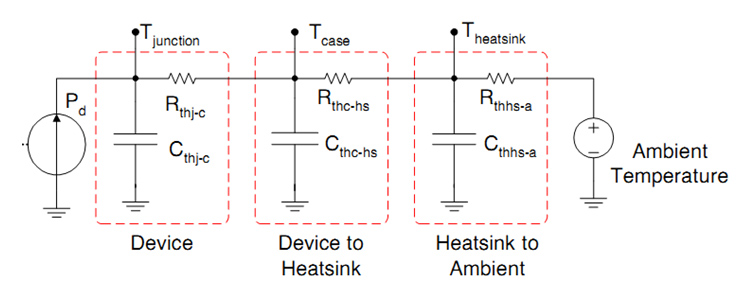
Figure 1: Thermal circuit
The following procedure provides a method to determine whether a heat sink is required. This example uses a semiconductor device, with the conditions listed below:
Using the junction temperature equation, calculate the junction temperature under the listed operational conditions:
TJ = TA + P × ƟJA = 50 + 20 × 4.7 = 144 °C
The junction temperature of 144 °C is higher than the specified maximum junction temperature of 85 °C. So, a heat sink is absolutely required to guarantee proper operation.
Using the heat-sink-to-ambient equation (and a ƟCS of 0.1 °C/W for typical thermal interface material), calculate the required heat-sink-to-ambient thermal resistance:
ƟSA = (TJmax - TA) / P - ƟJC – ƟCS
= (85 - 50) / 20 – 0.13 – 0.1
= 1.52 °C/W
Select a heat sink that meets the thermal resistance requirement of 1.52 °C/W. The heat sink must also physically fit onto the device. The thermal resistance of Z40-12.7B at an air flow of 400 feet per minute is 1.35 °C/W. Therefore, this heat sink will work since the published thermal resistance ƟSA is less than the required 1.52 °C/W.
Re-verifying:
TJ = TA + P × ƟJA
= TA + P × (ƟJC + ƟCS + ƟSA)
= 50 + 20 × (0.13 + 0.1 + 1.35)
= 81.6 °C
81.6 °C is under the specified maximum junction temperature of 85 °C. This justifies that the Z40-12.7B heat sink solution will work.
We would really like to hear from you and answer any questions. Please email us at info1@ascenten.net
or call us on
India Mobile: +91-89800 00973
India Landline: +91-79-2646 4646
Home | Careers | Ethics | Privacy Policy | Terms Of Use | Code Of Conduct

