
Home > Product Certification
Admin | Posted on 31/05/10
This article explains the saga of having electronic products certified for sale.
In order to be able to sell a piece of electronic equipment or device in a country, various certifications may be required to be acquired as per the appropriate governing regulations set by that country. Each country may mandate compliance with its own set of standards which would form a large stockpile of documents. However in most cases, such standards are derived from or are variations of a more internationally recognized standard such as the one laid out by the IEC (International Electrotechnical Commission). An example is the BS EN 55024, a British Standard that lays down the limits and methods of measurement of Immunity characteristics of IT equipment. This standard is derived from the European Standard EN 55024:1998 with the incorporation of amendments A1:2001 and A2:2003.
Now, literally there are thousands of standards, each with its own list of variations and amendments. The question is that how do we go about studying them and keeping abreast of the latest additions and modifications. While, for a particular electronic equipment to be developed, it might take some time to identify all required standards mandated by the target countries, studying them might not be as intimidating as it would seem at first. The reason is that most standards serving common purpose are derived from a common ancestor which makes their study easier. At Ascenten, continuous track is kept of the most commonly required standards as they are amended every year. Standards directly affect the development and their recommendations and limits must be put into effect right at the time of design. Most standard variations are directly advertised by the standard making body or are published in popular electronic magazines.
At Ascenten we segregate these standards mumbo jumbo into three categories namely Standards for Safety, Standards for EMC (Electromagnetic Compliance) and Other Standards.
More about these at a later note. For now let’s consider the procedure for having a piece of electronic equipment certified for compliance: As soon as first pre-certification prototypes are produced the design engineers take them to a testing agency for testing. There three things are done: first the device is tested for compliance to the specified standards, next if the device fails the engineers recommend design changes that are likely to help during retesting and once the device passes all tests, a test report is generated. Now, if the device fails at the first testing attempt, valuable time may be lost in making design changes, modifying prototypes and resubmitting the same for a new set of tests. Therefore at Ascenten, we have a practice of submitting several prototype variants for tests, especially the EMC tests, which at times may yield rather strange and unpredictable results. These X‑ray test/inspection labs maintain reasonable price points that make them viable for even small scale assembly lines. Some of these labs are also equipped with special BGA mounting equipment. These equipment operate on such high precision that an X‑ray inspection after assembly may not even be required. Such mounting techniques are recommended for high pin density BGA.
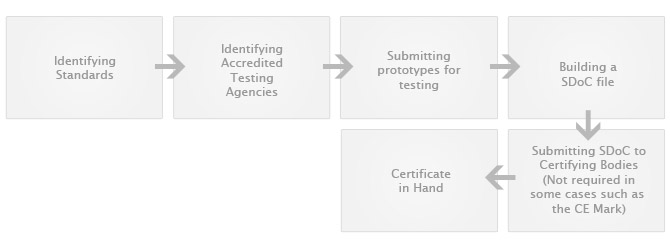
Once all required test reports are in place the next step is certification. Different regulations have different methods of certification. Certain regulations such as the CE Mark (necessary in the EU) do not require manufacturer to obtain a certificate, rather when necessary they require them to produce a Suppliers Declaration of Conformity (SDoC) which is a self declaration and a demonstrable, verifiable fact that the product conforms to all relevant directives and standards as tested by an accredited third party laboratory. In this regards the manufacturer must maintain a file of all relevant test and design documents.
On the other hand, an FCC Part 68 approval (in the US) requires the manufacturer to file the SDoC or the Telecommunication Certification Body (TCB) review report with the Administrative Council for Terminal Attachment (ACTA). The ACTA then files the report in a public database of FCC Part 68 approved products and issues a certification number that could be printed on manufacturer’s label as a public declaration of conformance.
EMC Compliance is voluntary in Japan and is supervised by Voluntary Control Council for Interference (VCCI) which issues a certification number upon being provided relevant test documents.
The certification process is outlined below:
Coming back to the standards mumbo jumbo, the three categories are detailed below:
These standards in general are meant to ensure that the product in its functional, non-working, or failed state is not likely to directly or indirectly harm persons, animals, or objects. The following table details country-wise standards requirements:
| Country | Service | Standard |
|---|---|---|
| United States | UL NRTL/C Mark | UL 60950, UL 61010, UL 60065 |
| United States | CSA NRTL/C Mark | CSA 60065, UL 60950, CSA 601, CSA 61010, C22.2 No. 225 |
| United States | UL-C Mark | UL 60950, UL 61010, UL 60065 |
| Canada | CSA Mark | CSA 60065, UL/CSA 60950, CSA 601, CSA 61010, C22.2 No. 225 |
| Europe | Self Declaration of Conformity (SDoC) | EN 60950, EN 61010, IEC 60065, IEC 60601 |
| Australia | Conformity declared by ACA accredited agency | AS/NZS 60950 |
EMC (Electromagnetic Compliance) ensures that electronic equipment neither emits excessive electromagnetic radiation nor malfunctions when exposed to it. The standards limit radiation from devices and define immunity tests:
| Country | Standard |
|---|---|
| United States | FCC Part 15 |
| Canada | ICES 003 |
| Australia | AS 3548 |
| Japan | VCCI – V |
| New Zealand | CISPR 22 |
| Europe | EN 55022, IEC / CISPR 22 |
| Chinese Taipei – Taiwan | CNS 13438 |
| Standard | Description |
|---|---|
| EN 55024 | Information technology equipment — Immunity characteristics — Limits and methods of measurement |
| CISPR 24 | Information Technology Product Specific |
| IEC 1000-4-2 | Electrostatic Discharge |
| IEC 1000-4-3 | Radiated Immunity |
| IEC 1000-4-4 | Fast Transients |
| IEC 1000-4-5 | Surge Transients |
| IEC 1000-4-6 | Conducted Immunity |
| IEC 1000-4-8 | Power Frequency Magnetic Field |
| IEC 1000-4-11 | Voltage Dips, Short Interruptions and Voltage Variations |
Depending on the application of the equipment, other standards may apply. For example, European aftermarket LPG/CNG automotive conversion equipment requires UNECE Regulation 115 conformance. Specific standards exist for medical and life-support devices.
The Restriction of the use of certain Hazardous Substances (RoHS) limits six substances in products:
RoHS requires a self declaration of conformity (SDoC). Manufacturers must ensure their products conform by either verifying the parts used or by third-party testing.
We would really like to hear from you and answer any questions. Please email us at info1@ascenten.net
or call us on
India Mobile: +91-89800 00973
India Landline: +91-79-2646 4646
Home | Careers | Ethics | Privacy Policy | Terms Of Use | Code Of Conduct

